Playing God by Sarah Zettel: From the SF Site Archives

Playing God

Now this is my idea of what science fiction ought to be — believable characters facing difficult and not entirely resolvable conflicts in a futuristic setting where plot and pacing take precedence over arcane technical speculation and long-winded philosophical digressions. Which is not to say that Sarah Zettel doesn’t have something weighty for us to ponder in Playing God — right off the title tells us there’s something here to think about. But unlike some more ponderous practitioners in the field, Zettel’s storytelling skills posit the bigger questions without the pedantry. Indeed, Zettel’s considerable gifts to spin a yarn have been compared to Asimov and Heinlein, but if you ask me (and since you’re reading this, like it or not you already have), she’s better. Sorry, all you die-hard Golden Agers out there, but there are times when the two Grandmasters get downright tedious, even ridiculous. Despite an occasional stumble (a confrontation that sets the plot rolling strikes me as incredibly unthinking for an otherwise smart character, though certainly a fair share of actual tragedies have resulted from amazing thoughtlessness), Zettel has produced the classic page-turner that sticks in your head long after you finally arrive at that last sentence.

One nice trick up Zettel’s prose sleeve is how she gets you to sympathize with the aliens as much — if not more so — than the humans. Praeis Shin is an exiled Dedelphi — a matriarchal humanoid society with a heightened sense of tribalism — called back to her native planet to muster support for a fragile new Confederation formed to cease an endless war between two major factions, the t’Theria and the Getesaph. Though neither trusts the other, biological warfare (initiated by the other side, that side always depending upon which side you’re talking to) has decimated their planet and their people. But because they possess only primitive late 20th century technology, the Dedelphi Confederation must place the fate of their world in the hands of humans — specifically by contracting with the Bioverse Enclave, a sort of corporate clan, to biologically scrub and reconstruct the Dedelphi eco-system. What’s in it for Bioverse? Unlimited access to radiation-hardened inorganic debris and living organisms representing a singular source of biochemistry that can be tapped for future lucrative eco-reconsturction projects. So Bioverse’s interests here are not purely mercenary. And what’s in it for the Dedelphi? The prospect of a plague-free future for their children. The question is whether the powerful inherent feelings of family can overcome their equally powerful — and certainly related — xenophobia.

As Zettel puts it in her afterword:

“All societies that evolve violent survival strategies (at least all the ones we know about) also evolve rules about who may be hurt or killed, and under what conditions. If a culture is not completely suicidal, some concept of peace, friendship, or trust must exist side by side with the violence. With the concept of killing comes the concept of not killing. The existence of these ideas can give a freedom of choice to individuals in their daily interactions, even when those are with strangers. The ultimate question is: Which way will the balance tip: toward evolutionary predisposition, cultural condition, or individual choice.”

While highly intolerant of other races and cultures within their own species, the Dedelphi have little trouble forming bonds of respect and friendship with humans. In an interesting twist (and certainly a refreshing bit of common sense for a genre in which aliens are often depicted freely intermingling and even mating with humans), unprotected long-term exposure to humans is potentially deadly to Dedelphi. But despite the necessity for humans to wear protective clean suits when living among the Dedelphi — and thus unable to engage in the constant touching by which tribal members continually reaffirm their relationships — two significant friendships form between the Dedelphi and humans: Bioverse’s project leader Dr. Lynn Nussbaumer with Praeis Shin of the t’Theria and Arron Hagopian, Nussbaumer’s former lover and Bioverse opponent, with the Getesaph. How those relationships play out, and how they affect the once intimate relationship between the humans, form the foreground against the Dedelphi conflict to explore “the ultimate question” Zettel asks.

Meanwhile, In the background, rebellious factions respectively within the t’Theria and the Getesaph plot to undermine the peace process and their evacuation to orbiting “city-ships” before the eco-reconstruction can begin. So you get your fast-paced action thrills and your philosophical ponderings all wrapped together in a nice package.

One thing I noticed about Zettel is that most of her central characters are female; indeed, the Dedelphi biology works in such a way that the only use for the male is reproductive. I don’t know if there’s some sort of feminist statement here (though it’s been made before) or if it merely reflects the author’s own gender orientation. In any event, there’s no heavy-handed proselytizing here. Zettel seems comfortable in presenting two major arguments of feminist speculation — superior female qualities put them in positions of power and dominance (Ursula K. Le Guin) and women have the choice and capabilities for the same nasty things as men, like wage war and seek revenge (Joanna Russ) — as givens. Which, some thirty years since Le Guin and Russ first published, you would kind of expect it to be.

While I was aware of the acclaim Zettel had received for her previous work (Fool’s War was a New York Times Notable Book of 1997 and Reclamation received the Locus Award for Best First Novel) this is my first exposure to her work. I suppose I passed on the earlier works just because my pile of “to-be-read” books was already spilling off my desk. Having read Playing God, though, I’m just going to have to add two more volumes to the pile and, with apologies to all those other books I still haven’t yet had the time to get to, put them right up on top.

The Best of Crank: From the SF Site Archives

The Best of Crank!

“This is art,” the professor for my science fiction graduate seminar had once proclaimed about the subject we were studying, even as he felt compelled to add, “though some of my colleagues in the English Department wouldn’t agree.”

Just as Frankenstein rejected his monster in the novel widely regarded as the progenitor of the form, high brow literary types have looked down upon science fiction as the bastard child of literature: something patched together from inferior stock and unworthy for anything but escapist entertainment for lesser minds.

As science fiction evolved as a, yes, art form, afficionados have resorted to various arguments to assuage their inferiority complexes, the two classic responses being:

 “Okay, so it’s not Shakespeare.  But, it examines the socio-political ramifications of the industrial revolution and humanity’s technical achievements and potential.”

 “Oh, yeah? If science fiction is such junk, what about 1984 and Brave New World, huh? What do you call that?”

Those kinds of arguments certainly had relevance during the tremendous technical innovations of the mid-20th century, particularly as they were applied to weapons of mass destruction and political control (remember that the wings of the space program were borne to flight on the work of Nazi scientists and specious fear of what would happen if the Russians got there first). However, the end of the Cold War made global nuclear destruction seemingly less of a threat while we got bored watching men landing on the Moon, so you don’t hear the first argument so much any more. So-called legitimate authors continue to use SF tropes (e.g., Margaret Atwood in The Handmaid’s Tale and, more recently, Gore Vidal in Smithsonian and newcomer Kirsten Bakis in Lives of the Monster Dogs) without increasing respect for the genre because they are marketed under different categories (e.g. “dystopia” or “post-modern” or “feminist”), just as Frankenstein gets into the canon because it’s “gothic.”

What’s really killing SF today are actually two things:

  1. If, as is generally theorized, SF first attracts (usually male) readers at the “Age of Wonder” (around 12), the problem is that the modern computer and the technologies it unleashed provide more literal devices of wonder than most tired tales of space opera.
  2. Star Trek — need I say more?

All of which brings us to The Best of Crank!

Crank! is an irregularly published magazine edited by Bryan Choflin. As someone who works in the publishing business, Choflin knows full well the problems confronting SF, which he describes in his introduction to this important volume:

“…if SF is going to continue in the long run, it needs to find a way to move forward, out of the (historically unprecedented) stagnant morass it is now. It is clear that clinging tightly to old ideas of genre is not going to work.”

A good place to start looking for that new launch pad is in the pages of The Best of Crank! The not inconsiderable obstacle that Choflin faces, however, becomes immediate apparent upon scanning the table of contents. Although some of the names may be familiar to SF fans (most notably, Ursula K. Le Guin and Brain Aldiss), many won’t (just who is Eliot Fintushel?). The great irony is that even the “name” authors might not have so much as a single representative volume shelved on their behalf in the mall bookstore, or even in the mega-chain, while entire sections are devoted to Star Trek and X-Files spin-offs. As Choflin puts it:

“In spite of (or even because of) the enormous success of the SF-derived mass entertainments of the movies and television, SF books still remain below the radar of many readers and reviewers of non-SF books. In recent years, there has been a marked increase in the number of books published outside the SF category that are essentially SF books, making use of conceits that have been common currency in SF for decades. But the publishers are reputable literary houses, and the books are simply published as ‘fiction’… if these same books were published under an SF imprint, they would also be ignored.”

By thinking solely in terms of genre, readers who limit themselves to the familiar are stuck with a lot of junk, unaware of the richness of new authors and literary innovations; by the same token, the mainstream ignores quality work if it is called SF.

Choflin says to hell with all that. “The stories in this book reflect [my] esthetic agenda [of] a deliberately anti-generic selection.” Indeed, much of this is more fantasy than SF, though even that distinction is kind of meaningless. What’s here is literature. At times it annoyed me, puzzled me, frustrated me. But, above all, it made me think.

The cream here is Michael Bishop’s “I, Iscariot,” in which Judas is “virtually resurrected” and put on trial as a mass entertainment. Turns out that Judas got a bum deal because he kind of liked Jesus’s bum, and although the real perpetrator is fingered in the end, just as Jesus found in taking the walk to the cross, fate cannot be escaped. It’s no wonder that this story appears in the one back issue of Crank! that is no longer in print. You could justify buying The Best of Crank! for this story alone.

Keeping with the eschatological theme, almost as intriguing is “Homage” by A.M. Dellamonica, in which the God of Entertainment assumes the throne of Hades by enticing souls through a popular medium. A.A. Attanasio’s “The Dark One: Amythograph” also explores the meaning of existence, although with an outcome that struck me as typical of the genre. Along the same lines, although I liked Le Guin’s “The Matter of Seggri,” the subject matter may have been avant-garde during the New Wave, but the point about sexual roles has been made repeatedly, the author herself being one of the pioneers of feminist SF. Maybe the point is that even after all these years, the point still has to be made.

Choflin seems to favor fables, exemplified by the tales of Jonathan Lethem (who accounts for three stories, as well as another written with Carter Scholz). My favorite of these Lethem tales is “The Happy Prince,” which recounts the ill-fated love affair between a handsome and well-endowed servitor robot and a swallow (yes, you read that right). The titles “Nixon in Space” and “Santacide” give fair warning about just how weird some of this gets. Even that may not prepare you for “Food Man,” in which Lisa Tuttle puts a spin on an eating disorder that could possibly lead to literally eating your heart out. Another example of weird excellence is the modern morality tale by Gwyneth Jones.  In her “The Thief, the Princess, and the Cartesian Circle,” a disturbed young woman finally manages to find her Prince Charming with a happy ending that maybe can happen not just in fairy tales. And then there’s Robert Deveraux’ “Clap If You Believe,” about a young man who asks a father for the hand of a pixie (as in Tinkerbell) in marriage — if you’re wondering how such a relationship can be consummated, Deveraux gives you an idea.

Weird for the sake of weird doesn’t always work, however. Karen Jay Fowler tries to dress up the Le Guin theme from a post-modernist perspective in “The Elizabeth Complex” by trying to echo the story of Henry VIII’s daughter with a series of contemporary Lizzies. This is the one story that just doesn’t work at any level for me. Similarly, David Bunch’s “The Soul Shortchanges” strikes me as kind of retread territory, even though I liked its smart-ass attitude.

Choflin is a champion of the writer R. A. Lafferty, whose “I Don’t Care Who Keeps the Cows” — a parable of how we got so smart and why we’re not as smart as we used to be — is included here. Another on Choflin’s list of admired writers is Gene Wolfe, whose “Empires of Foliage and Flower” presents yet another fable about the absurdity of war.

Just as I got The Best of Crank! to review, I happily received the long-awaited latest issue of Crank! For a variety of reasons, not the least of which is that Choflin is a solo publisher without university affiliation, arts grants, or a staff of gophers, two years have passed between issues. Choflin promises to get back on the quarterly track, with a redesigned logo that drops reference to “science fiction or fantasy” — Choflin prefers to present Crank! simply as a literary magazine, albeit one with a bizarre bent. Just to drive home the point, the first story, Carol Emshwiller’s “A is for Abel, B is For Bird,” about how a strange pair of misfits get stuck to one another, is not science fiction though, perhaps, it is borderline fantasy. Also, while Eliot Fintushel’s hilarious “Galactic Business” deals with time travel and threats to the end of the universe, I don’t know if SF has ever used masturbation as a story idea. In any event, this story gets my nomination for inclusion in the next Best of Crank! volume. Finally, long-time subscribers will be pleased to at last read the final installment of James Blaycock’s novel, The Magic Spectacles, the first part having been published in the winter of 1996!

Choflin is a man with a mission, and, like most missionaries, the experience has not made him richer. He needs your help. Science fiction as literature needs your help. Subscribe to Crank! (have you figured out by now why it’s called this?) — a measly $15 for four issues. (By the way, I’m a subscriber and am not just getting reviewer copies, so I put my money where my mouth is.) If you’re interested in the Best of Crank!, buy it directly from Choflin rather than through the chains or the Internet book stores — Cholfin makes a bigger profit when you skip the retailers, and can pour more of those profits into sustaining the magazine.

Go ahead. Do it. You’ll feel much better for it for doing your part to help ensure that the literature of the future has one.

Armageddon Summer: From the SF Site Archives

Jane Yolen died on June 11, 2026 at the age of 87. Here’s my 1998 review from the SF Site archives of her co-write with Bruce Coville. Right now it feels like Armageddon Summer for a whole lot of different reasons.

Armageddon Summer

When I was a kid, the year 2000 represented “The Future.” To me, and for the books that I was reading, that meant space travel, aliens, sleek uniforms, and a glimmering new shiny world.

Now that the new millennium that once seemed so far away is almost here, instead of a new world, some people see the end of it. Of course, the Millennialists, as they are sometimes called, are nothing new under the sun. Early on in the history of Christianity, there were followers of Jesus who fully expected the end of the world in their lifetimes, and downtthrough the ages, many Christians have expected the prophecy in the Book of Revelation to come true at some significant calendar event. One such great burst of millennialist spirit came when 1899 became11900, and later in the century, the invention of nuclear weapons seemed to finally usher in the fiery destruction of Earth, albeit a couple of decades early.

But, the Y2K programming problem notwithstanding, most of us expect to still be around as we approach yet another new millennium, if only because previous experience tends to bear us out.

Which brings us to the subject of Armageddon Summer, yet another edition in the Jane Yolen prolificacy project, and this time written in conjunction with equally well-known children’s and young adult writer, Bruce Coville. The world is scheduled to end on July 27, 2000. Or, at least so says Reverend Beelson as he brings his flock of 144 (the number of the twelve apostles squared, no more, no less) to a mountaintop retreat to await their salvation while the rest of humanity have their “greasy souls fried.” While this self-styled Armageddon (a mountain identified in Revelation 16.16 as the future site of the final battle between the forces of good and evil) does become a fiery scene of retribution and destruction, it takes the form of a secular tragedy unforeseen by the Reverend (whose name has connotations of Beelzebul, generally interpreted as a name for Satan, sometimes as “Enemy” or “Lord of Dung”).

Among the 144 are two teenagers, Marina and Jed. The projected end of the world also happens to coincide with Marina’s fourteenth birthday, and complicating matters further is the mutual crush emerging between Marina and Jed. Marina’s mom thinks Jed is a “devil-boy.” She is estranged from her husband and seems attracted to the unattached Beelson, while Jed’s father is also separated from a spouse who does not share belief. Both adults are reconciled to the puzzling notion that they will somehow be saved, while those they once loved and left behind are fated for certain destruction.

Since this is a novel aimed at young adults, it is perhaps not surprising that the kids have more sense than their befuddled parents. While Marina believes in God, she has a hard time reconciling her conception of God’s fairness and goodness with Beelson’s prophecy. Jed is an outright non-believer, reluctantly going along with this tiresome ordeal to watch out for his father while waiting for things to get back to normal beginning on July 28th. He is not quite successful at this.

The novel has a lot of fun at the expense of fundamentalist ideology (“I actually said a prayer of my own, my first since we had arrived: Please God, get me out of this nuthouse.”), particularly in pointing out the disturbing contradictions of why some people should be saved, while unsuspecting others face obliteration. The authors also seem to make the case that some people’s emotional instabilities make them ripe for these kinds of unwitting beliefs. Yet, all is not black and white, even when dealing with such an easy target as the irrationality of cultists. Jed learns that he can like, even respect, people whose ideas are far-fetched, and goes so far as to develop an ambivalently sympathetic relationship with Reverend Beelson that mixes contempt with admiration.

Still, this book isn’t going to sell in the Bible Belt. If any of the Religious Right bother to read this book, they’ll probably want to ban it. But, then, they probably won’t get the underlying message of tolerance, either, or the way both Marina and Jed come to discover their own inner strength by developing an indeterminate but reassuring faith in something larger than themselves.

Young adults are likely to get easily caught up in the plot, wondering how exactly the end of the world comes about, and are certain to be suckers for the love story. The theological ponderings lack the sophistication of, say, James Morrow, but are likely to coincide with the intended audience’s own questions about the meaning of it all. This is not, however, a work of science fiction or fantasy, so, despite Yolen’s presence, some readers might be disappointed that angels appear only figuratively.

The story is conveyed by alternating chapters written by Marina and Jed, which also serves as neat device for collaboration. Yolen wrote Marina’s parts, and Coville Jed’s. They both get the voice of an adolescent down pat, although that’s perhaps not surprising considering their experience in writing for that age. Apparently, they had originally thought about writing the book via email. I Instead, Coville drove 500 miles to Yolen’s house and together they produced much of the book during an intense week of writing. According to their publicist, “Jane would write a chapter from Marina’s point of view and then give it to Bruce, who’d write Jed’s chapter and then give it to Jane. Their mutual competitiveness spurred them on.”

With that in mind, you do get the sense at times that the end of each chapter is a sort of throwing down the gauntlet to say, “Hey, top this” or “Okay, how are you going to resolve this situation?” If that was the approach, it was effective. If there’s a couple of places where it seemed to fall flat, well, it certainly didn’t prove to be the end of the world.

The BFG: From the SF Site Archives

The Roald Dahl play (with John Lithgow in the title role) is closing at the end of the month. Here’s an old (1998) discussion of the BFG from the SF Site archives.

This is not the kind of book you want to read at bedtime to lull your children asleep. Not because it’s scary (although it has elements of that); not because some of the material will go over their heads (ditto, something for the parents to appreciate); and not because kids won’t understand it (they’ll love it). No, you may not want to read this to your kids at bedtime because it will keep them up laughing too hard.

I know. I made the mistake of selecting The BFG for bedtime reading with a pair of eight-year-olds during an end-of-summer vacation. They were giggling all night long. And once I started, there was no hope of substituting something more soothing to entice little girls to dreamland.  The BFG was better than REM.

While you may know that REM is both a crucial stage of sleep and the name of a rock band, you might be wondering what exactly the BFG is, and, more to the point, what the “F” stands for. Of course, it’s not what you think, but this being Roald Dahl, I’d say it’s safe guess that the thought crossed his mind that some of you adults might take it the wrong way. And somewhere he’s probably still smiling about it.

The BFG is the “Big Friendly Giant,” which is fortunate for Sophie. Most giants (there are a total of nine, among them ones with considerably less enchanting names, such as Bloodbottler, Bonecruncher, and Fleshlumper), snack on little children. But not the BFG.

“Just because I is a giant, you think I is a man-gobbling cannybull… You is about right… Bonecrunching Giant crunches up two wopsey whiffling human beans for supper every night! Noise is earbusting! Noise of crunching bones crackety-clack for mile around!”

“Ouch!” Sophie said.

“Bonecrunching Giant only gobbles human beans from Turkey,” the Giant said. “Every night Bonecruncher is gallopping off to Turkey to gobble Turks.”

Sophie’s sense of patriotism was suddenly so bruised by the remark that she became quite angry. “Why Turks?” she blurted out. “What’s wrong with the English?”

“Bonecrunching Giant says Turks is tasting oh so ever much juicier and scrumdiddlyumptous! Bonecruncher says Turkish human beans has a glamourly flavor. He says Turks from Turkey is tasting of turkey.”

“I suppose they would,” Sophie said.

“Of course they would!” the Giant shouted. “Every human bean is diddly and different. Some is scrumdiddlyumptous and some is uckyslush. Greeks is all fully of uckyslush. No Giant is eating Greeks, ever… Greeks from Greece is all tasting greasy…”

What sort of human beans do you eat?”

“Me!” shouted the Giant. “Me gobbling up human beans! The others, yes! All the others is gobbling them up every night, but not me! I is a freaky giant. I is a nice and jumbly Giant. I is THE BIG FRIENDLY GIANT. I is the BFG. What is your name?”

“My name is Sophie,” Sophie said, hardly daring to believe the good news she had just heard.

Though he doesn’t plan to eat Sophie, the BFG is constrained by Giant etiquette to take Sophie back with him to Giant land because the little girl has seen him. Can’t be letting word get out about Giants because the next thing you know there might be a big giant-hunt and the BFG would wind up in a zoo. So Sophie will have to stay with him. Which is okay by Sophie, since it beats living in the orphanage, but she simply can’t stand by and let the other Giants go about munching on innocent children. So she manages to persuade the BFG — who is a bit of misfit himself among Giants — to help her convince no less a personage than the Queen of England on the need to forcibly convert the Giants to a sort of vegetarianism that is actually a punishment, not a healthier life style.

As the quoted passage above should illustrate, what makes The BFG so endearing are the descriptive malapropisms (wait to you get to the “whizpoppers”) and bad puns. As usual in Dahl territory, there is a precocious child smarter than the befuddled adults, as well as the underlying fairly tale themes of a lost child whose status as an outcast provides the necessary strength to overcome an ordeal.

I began reading the Dahl canon to my daughter when she was six. Even when a lot of the material was way over her head, she’s never failed to be thoroughly enchanted. Neither will you.

The Borrowers: Borrowed from the SF Site Archives

The Borrowers Movie
The Borrowers Aloft

People are often disappointed when a movie isn’t the same as the book it’s based upon. Generally speaking, movies usually have a hard time matching the complex interactions between readers and words. So it’s no wonder they usually don’t measure up.

Which is why it’s best to consider movies as adaptations of the books on which they are based, not literal recreations. Revisions to characters and plot structure are oftentimes necessary to focus on significant themes that can be adequately expressed cinematically within two hours. With some notable exceptions (The Indian and the Cupboard, for example, which is very much like, and every bit as good as, the Lynne Reid Banks novel), movies and books are, by definition, horses of other colours.

So it’s no great shakes that The Borrowers movie takes some liberties with Mary Norton’s original characters. It’s actually a pretty good kids’ movie (vastly superior to some, like Flubber). Better yet, the movie isn’t tied in with tons of merchandising to convince your kid he needs lots of useless plastic junk. And generally I like movies that will get kids interested in reading books. What I don’t quite get is why a need was felt to create a movie novelization when there are already five perfectly good Borrowers books?

Well, maybe they aren’t “perfectly good” in terms of marketeers expectations of what most children are interested in reading. The novelization repeats the modern setting and slightly reconfigured relationships among the Borrowers — Peagreen (who, in the original series, doesn’t appear until the fifth and last volume) is recast as a little brother to Arietty Clock, adolescent daughter of Pod and Homily Clock, and Spiller is more clearly made out as Arietty’s romantic interest. Bad guy lawyer (there’s a contemporary symbol of evil for you) Mr. Potter is out to steal the house away from where the Borrowers and young Pete Lender — a “human bean” — and his parents have lived. Pete and the Borrowers join forces to make things right. Mary Norton might not have objected much to the “poetic license” taken with her characters, but somehow I suspect she might consider the inclusion of a flatulent bloodhound to be in poor taste.

I was immediately struck by how much shorter (105 pages) The Borrowers tie-in novel is compared to the original books, The Borrowers Aloft (224 pages) and The Borrowers Avenged (298 pages). Not surprising, perhaps, considering that a movie plot depends considerably less on characterization and narrative development. But the language is also simpler, more direct, nary more than one dependent clause per sentence, if that. My own eight year old daughter, Sydnie, easily breezed through the novelization (she’d previously seen the movie), but I chose to read The Borrowers Aloftand The Borrowers Afield to her. While all three books are labeled for ages 8 and up, I think readers typically at the younger end of that spectrum — particularly readers who watch movies more than they read — would have some difficulty with Norton’s prose.

Truth to say, at times I had trouble with Norton’s prose. For one thing, it’s set in pre-World War I England, so there’s all sort of references that will go past kids who might not immediately get what is so unusual about a ringing telephone. Moreover, Norton spends a lot of time explaining how the tiny Borrowers manage to construct ingenious devices based on cast-off household items to the point of tediousness. I’ve never been one of those SF readers who is inordinately fascinated with how the warp drive might actually work in the context of existing quantum theory. In fact, I don’t much give a damn — it’s the story that counts for me. So you’ll understand how chapter after chapter devoted to the construction of a miniature hot air balloon would start to wear on me.

On the other hand, I do realize that’s the sort of thing that actually hooks some kids (usually boys) into reading, particularly science fiction. Nor did my eight-year old daughter, Sydnie, voice any impatience over these sections. Maybe she’s going to grow up to be an engineer. Still, I suspect that if Norton were just getting started in the business, rather than already being a revered children’s author, she’d be getting a lot of rejection slips. Not enough action, too many long sentences. Fortunately for kids who have more going for them than the media conglomerates give them credit for, Norton’s work is still around, and the movie may inspire kids to read the more challenging material.

Although The Borrowers Aloft and The Borrowers Avenged are the concluding books of the series, you needn’t have read the previous stories, though I’d recommend reading these two books in the proper sequence. Interestingly, although they are linked together and read like a single story, their dates of publication are separated by 21 years.

Basically, The Borrowers Aloft is about how the Clocks escape the Platters, “human beans” who’ve imprisoned them in their attic. The Platters hope to make their fortune by exhibiting the poor Borrowers in captivity, a horrible prospect for creatures who consider being “seen” by humans a fate worse than death. (Note to the publisher: the cover illustration gives away the means of escape; as soon as we got to the part where the Platters locked the Borrowers up, my daughter immediately announced she knew how they were going to get out.)  The Borrowers Avenged picks up how the Clocks come to find a new home, meet Peagreen (ambiguously cast as a rival to Spiller for Arriety’s attention), are reunited with another Borrower family, the Hendrearys, and have one final encounter with the Platters that ends badly for the scheming “human beans.” Beneath the simple plotting, there are suggestions of more complex matters. Norton seems to be making fun of people who put on airs either by accident of birth (the “Overmantels” live both figuratively and socially “above” other Borrowers) or choice (churchgoers whose outward attempts at devotion fails to hide their true natures). And the question of whether Borrowers can ever speak with “human beans” — Pod is adamant against it, while Arriety breaks the taboo — echoes all sort of cultural conflicts.

Norton doesn’t insult her readers with clear-cut happy endings; there’s a question left at the end of both novels about good intentions and whether they’ll be followed through on. (Indeed, there are enough loose ends at the finale of The Borrowers Avenged that Norton was at least allowing for the possibility of yet another volume, even if she never got around to writing it.) And the fact always remains that the outside world is a potentially dangerous place. Nor do we ever find out who — Spiller or Peagreen, if either — finally gets the girl.

The stories did get my dughter’s attention, though. “The Borrowers was all right, but I already knew what was going to happen because I saw the movie. But The Borrowers Aloft and The Borrowers Avenged were more interesting,” says Sydnie. “You get excited about how the characters are going to get out and what happens to them.” She also says that her favorite characters are Peagreen and Spiller, Arietty’s two potential suitors. Hmmm. Don’t know if I like the sound of that, if you’ll excuse me for being a bit Pod-like. Then again, when it comes to their daughters’ emerging interest in boys, fathers are the same, no matter what their height.

Two Richard Calder Novels: Another SF Site Excavation

The story goes that in rejecting J.G. Ballard’s auto- (in the literal sense of vehicular) erotic novel, Crash, an editor commented that the author should seek psychiatric help. If that editor ever read Richard Calder, he would undoubtedly recommend immediate institutionalization.

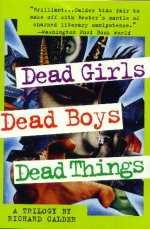
But as R.D. Laing used to argue, in a lunatic reality only the crazy people are sane. As crazy as Calder’s fictional reality (actually, there are multiple, though linked, realities) may be, it aptly reflects our own materialist-narcissistic culture.  Dead Girls, Dead Boys, Dead Things depicts a mid-21st century society consumed by its own consumerism: “designer dolls” (fully functioning androids) transmit a virus through sexual relations with humans that eventually infects female offspring, slowly transforming these children into dolls, beginning at about the time of puberty. Hence the term, “Dead Girls” (and, as you might gather from the full title, the virus progresses to cross genders). The metamorphosed dolls gradually turn completely into automata, and die by their early 20s. They are virus carriers, and consequently under quarantine, although some manage to escape to Thailand (some things in the sex business never change). When the Human Front gains political power, it is no longer a question of quarantine, but of eradication.

Did I mention that Calder has written a love story? With a happy ending, no less.

Calder’s work has been variously described as “cyberpunk” (which has become a catch-all term for any non-linear narrative that in any vague way deals with techno-biological enhancements of humanity), “splatter-punk” (explicit sexually-related violence), and vampire fiction (the mutation of girls into dolls includes the growth of fangs to suck blood and infect humans). Perhaps it’s not surprising that Calder has inspired yet another in the now rather tired series of “punkisms” — this time, it’s “necro-punk” (a character performs cunnilingus on the removed sex organs of his deceased doll girlfriend, to give you an idea). My own take is that Calder is an avatar of Philip K. Dick, employing these various genres to further develop notions of alternate realities and states of being, mixed with a hefty dash of Eastern mysticism. (I resist calling that “Dick-punk,” as much as I like the double entendre.) In an interview with Richard Calder, he cites as influences Marcel Proust, Angela Carter, Vladimir Nabokov, Michael Moorcock and Mervyn Peake, as well as Buddhism, which helps gives you a picture of the strange brew here.

Reading Calder is tough-sledding for a variety of reasons. The explicit violence can be off-putting, although it’s hardly gratuitous. Indeed, the detailed descriptions of murder and evisceration eventually become tedious, taking to an extreme our own culture’s obsession with violent images and subsequent desensitization to brutality.

Another is the curious fact that Dead Girls, Dead Boys, Dead Things was originally published as three separate volumes of a trilogy. While Dead Girls could stand alone (not an uncommon trait for most trilogies), Dead Boys not only seems an unfinished work (also not uncharacteristic of trilogies), it is virtually incomprehensible without the framing first and third stories. Needless to say, Dead Things won’t have near the impact it does without reading the first two stories. Someone randomly picking up Dead Boyscould easily fail to get through the first few chapters; moreover, I suspect the same bewilderment could happen to someone who had already read, and even liked, Dead Girls. My advice: hang in there. The rewards are there in reading this as a single, complete (409 page) novel, if you’re willing to undergo some difficult parts. Of course, that’s the way it is with a lot of literature, you know, like the things you have to read in college. But don’t let that put you off, either.

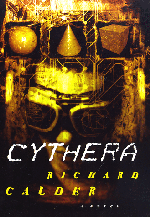
Cythera is published as a novel, although the narrative is constructed the same way as the trilogy — three stories (with different narrators) of seemingly disparate characters and events that ultimately link-up. There’s considerably less graphic violence, although we’re in the same fictional world of Dead Girls, Dead Boys, Dead Things; indeed, Cytherafeatures two minor characters from the earlier work, and it might be difficult to follow certain parts without first having read the trilogy. Even then, it’s difficult to follow in parts.

Cythera posits several Earth realities (numbered 1, 2, and 3), which may or may not be computer-generated simulacrums, that begin to interact with one another. Computer programs (called ghosts) from Earth-2 have managed to download themselves as corporeal beings in Earth-1. One character pursues his relationship with a ghost by committing suicide and downloading his consciousness into Earth-2. Meanwhile, a film producer who believes he’s been abducted by aliens and had his consciousness altered in some insidious fashion is searching for Earth-3, thought to be an ultimate reality called “Cythera.”

I’m unsure of what this name is supposed to mean. The way it is pronounced — sith-er-ah — connotes “synthetic,” and certainly there is a lot synthetic in the novel, from the ghosts and automata to the concept of reality itself. There’s nothing about the title I could find that might be related to Oriental mythology, which you might expect given Calder’s interest in Buddhism. There might, however, be a Greek connection. According to Liddell and Scott’s Greek-English Lexicon (and thanks to Neil Walsh for pointing this out):

“Cytherea is a surname of Venus, from the city of Cythera in Crete, or from the island on the south of Laconia, now Cerigo.”

Given the obsession of Calder’s characters with finding true love — albeit in bizarre ways — the association with the goddess of love makes sense. Considering also that the last third of the book takes place on an island called Kithira and that in the original Greek Cythera would also be pronounced with a hard K sound, this admittedly obscure reference may not be so much of a reach. As to what the title of the planned sequel, Frenzetta (tentatively slated for December release), is supposed to mean, I haven’t a clue.

By the way, this is also a love story.

I haven’t even begun to touch on the various tropes and themes Calder’s work deals with. Often, he’s quite funny. There are a host of sly allusions to pop culture, SF, pulp, and noir movies. At times he seems compelled to make obvious his otherwise obliquely stated themes, which I think distracts a bit from the effect, as if he needs to make sure we “get it.” At times, I’m not always sure I’ve gotten it, but I also think that’s part of the point.

In my review of The Dreams Our Stuff Is Made Of, Thomas Disch champions Edgar Allan Poe as the originator of science fiction, as opposed to Mary Shelly’s more literaryFrankenstein. One element that Calder certainly shares with Poe is what Disch describes as “grossness” — vivid descriptions of putrefaction and death that make the reader uncomfortable not only within his own skin, but within larger human society. In this, Calder succeeds only too well (in the Dead trilogy, there’s a joking reference to a dance club with an “Edgar Allan Poe” motif). In Cythera, however, the connection withFrankenstein — and literary ambition — is all the more clear. The search for Cythera begins and culminates in Antarctica, reminiscent of Dr. Frankenstein’s own final chase of the monster in the frozen tundra. Equally significant, at one point the major character is addressed as “a monster.”

Make no mistake about it, this is a literary work in the fine tradition of Mary Shelley. If you have any interest at all in science fiction that presents serious art, you must read Richard Calder. As Herman Melville might have said, prepare for some rough sailing, but the prospect of transcendentally tranquil seas on the horizon make it well-worth the voyage.

Asimov’s Science Fiction, June 1998: Yet Another From the SF Site Archives

Asimov's SF, June 1998

The June issue of Asimov’s SF marks a new larger look (an inch taller and a quarter inch wider) which editor Gardner Dozois points out results in 10% more content despite a 16 page reduction for a single issue. While this may help Asimov’s SF distinguish itself from the crossword puzzle and soap opera digests with which it appears in the Wal-Mart magazine aisle, the still inexpensive stock won’t draw eyes from the more glossy literary magazines in the book stores. The latter, however, are generally more expensive and published quarterly, which makes Asimov’s SF monthly selection of everything from short fiction to poetry to novellas coupled with book reviews and commentary quite a bargain.

Then again, I somehow doubt that Asimov’s SF and The Iowa Review share the same target audience.

Ironically, in his “On Books” column, Norman Spinrad worries about the continued commercial viability of the very type of mainstream SF you’d expect from a magazine christened for Isaac Asimov, namely:

“…science fiction and fantasy written in serviceable and accessible transparent prose, more or less conventionally structured, and featuring protagonists with whom the ordinary reader can readily identify on a psychological level, but informed by serious speculative intent …”

Spinrad sees hope for “sincere, intellectually demanding, literally interesting, spiritually alive SF” out on the fringes of the genre, citing such authors as Graham Joyce, Paul Di Fillipo, and Tim Powers, as well as powerfully recharged work by an old straight-ahead SF writer, Damon Knight. Based on this issue, Asimov’s SF is sending some probes to the fringe regions while maintaining a home base in the terra firma of the mainstream.

What comes closest to a fringe work here is Ian McDonald’s “The Days of Solomon Gursky,” while still keeping a foot in the “traditional” SF camp, i.e., speculation on the origins of the universe drawn from current cosmological theories, a likable protagonist, a happy ending. My favourite story of the issue, this is a wonderful riff on the “If I could do it all over again” theme. As you might expect with a character named “Solomon” and a novella that is divided into the seven days of creation, there are also biblical motifs about division and birth. The writing is wonderfully imaginative, although at times you have to work a bit to figure out what’s going on (a characteristic of “fringe” work), but that’s half the fun. The issue is worth the purchase price for this story alone.

A close second is “Lovestory” by James Patrick Kelly (who also inaugurates a regular column about surfing the web, a subject that should be of interest to SF Site readers). Kelly effectively portrays a society of furry humanoids who have three sexes, the result of a division in the female role between the conceiver and the gestater. Kelly draws a vivid picture of this tri-gendered society (much more successfully than, say, Ursula Le Guin’s vaguely depicted hermaphrodites in The Left Hand of Darkness). However, his ruminations on the difficult decisions and sacrifices a mother makes on behalf of her child would strike me as more radical — and hence more on the fringe Spinrad celebrates — had it appeared during the New Wave era when feminist SF first began shaking some the genre’s foundations.

But, enough of this academic posturing. Wherever they belong on the literary continuum (if you care about such things), these are two damn fine stories.

Equally worth attention is Paul J. McAuley’s “17.” More firmly rooted in the mainstream, it’s a fine evocation of how the underclass is exploited by technocracy, featuring a character with the street cunning and opportunity to rise above her circumstances. The story ends with the character exchanging one form of exploitation for another, although one half-expects that she’ll find a way to beat the system. This reads like the opening chapter of a novel — if that’s not McAuley’s intention, I hope he’s at least considering additional stories centred on this character.

“Red” by Sarah Clemens is a werewolf story set in the 1960s South which succeeds in establishing parallels between the end of a destructive monster and the emerging demise of institutional racism (at least de jure with the historic passage of the Civil Rights Act). You have to think a bit about this nicely written story before you get it (or at least I did), so in that sense it’s a more “literary” work. Not SF in the traditional sense, but it reminded me of the type of story that would pop up among the legendary collections of Judith Merril. Again, the story’s meaning would have had a more radical resonation had it appeared during that time (but, then again, wasn’t everything more radical in the 60s?). I wonder if a reader who either didn’t grow up then or hasn’t at least passing familiarity with its gestalt will fully understand it.

Things go downhill a bit from here. “The Moon Girl” by M. Shayne Bell relates the narrator’s discovery of an 18th century explorer’s notes about an encounter with an alien. Needless to say, this has been done before, and unless I’m missing something, it doesn’t add much to the literature beyond mimicking the form. Similarly, “Target of Opportunity” presents a “time travellers going back to the dinosaur age” scenario, and while there’s some imaginative description by Stephen Dedman, I didn’t find the denouement overly fulfilling or original. Besides, I think Ray Bradbury did this best way back with his “A Sound of Thunder,” and without need of a bunch of techno-speak to make it interesting.

This kind of retread stuff fails to reinvigorate mainstream SF in a way that effectively evokes the “sense of wonder” that attracts new (traditionally male adolescent) fans and boosts circulation. Admittedly, it was easier to do this in the days before the Star Wars trilogy, PalmPilots, and NASA websites featuring the latest vidcaps from Outer Space. Thus in his regular “Reflections” column, Robert Silverberg in “The Science Fictionalization of Everything” echoes David Hartwell’s complaint (from Age of Wonders — recommended reading) that “When science fiction comes true, it’s no longer fun”:

“I’ve lived long enough, now, to see all these fantastic notions perfected and turned into the innate essence of our daily mundane reality… I was drawn to science fiction in the first place because I passionately cared about all those fantastic things… and yearned with all my heart to live long enough to see them turn into reality. The day I start reacting coolly and indifferently to the sight of a foot-high six-wheeled gizmo scooting around piles of sand on Mars is the day I put my cherished files of half-century old copies of Astounding Science Fiction out for the next Goodwill pick-up…”

The problem may be that generations raised on laptops, genetic manipulation, and interactive role-plays may not be astounded by some of the SF represented in Asimov’s SF. More journeys to colonize the fringe, then, may be necessary to preserve the continued health of the species. Of course, periodicals like CRANK! pride themselves for living on the edge, but come out only quarterly, if that (I haven’t seen an issue of CRANK! since 1996, unfortunately). After over 20 years, Asimov’s SF remains a dependable source to take a regular pulse of the genre. Here’s hoping it retains a vital beat.

Note on re-reading this post in 2026: The last couple of paragraphs resonates today, what with AI, a techno-billionaire oligarchy, and a the shitification (to use Cory doctor’s term) of the Internet, to name just a few of what was once thought a product of the imagination, rather than a product for an IPO.

The Dreams Our Stuff is Made Of: From the SF Site Archives

This book is as clever as its moniker in explaining (a bit hyperbolically, perhaps, but fittingly for the genre) its somewhat misleading subtitle of “How Science Fiction Conquered the World.” This isn’t a tome about the ways SF back in the 40s and 50s predicted today’s technology (even if it was as often wide of the mark for all the times it hit a bullseye), although there is some reference to this phenomenon. Of far more interest, Thomas Disch points out how popular culture has inculcated SF metaphors (often not the particularly sophisticated ones) to the point where some folks (UFO abductees, Scientologists, Heaven’s Gate suicides, jurors in Star Trek uniforms) can’t tell the difference between the real and the made up.

The author himself was one of the Young Turks of the New Wave, so you also get an insider’s look at many of the personalities that helped perpetrate the cultural crimes and misdemeanors Disch charges to SF. I suspect I share with many my excitement in seeing Disch returning to SF, even if in a work of non-fiction (since the early 80s he’s published mostly poetry, gothic horror and criticism, as well as plays and interactive software). For those needing a bit of background, however, The Encyclopedia of Science Fiction (edited by John Clute and Peter Nicholls, Groiler CD version) has this to say:

“His virtual departure from SF may be not unconnected to the nature of the field’s response to him. Because of his intellectual audacity, the chillingly distanced mannerism of his narrative art, the austerity of the pleasures he affords, and the fine cruelty of his wit, [Disch] has been perhaps the most respected, least trusted, most envied and least read of all modern first-rank SF writers.”

That wit (though it doesn’t strike me as cruel, unless in the sense that the truth hurts) is in fair abundance here. Chapters with titles such as “When You Wish Upon a Star — Science Fiction as Religion,” “Star Trek, or the Future as Lifestyle” and “Republicans on Mars — Science Fiction as Military Strategy” all crack jokes while expressing astonishment over the extent to which certain SF conceits are taken seriously by the mainstream.

Though Disch claims he did not set out to write a history of SF, it nonetheless provides a handy overview, albeit with Disch’s pointed emphasis on the commercial, as opposed to literary, works which he believes have had the most cultural impact. For this reason, Disch makes a most persuasive case for Edgar Allan Poe — not the more erudite Mary Shelley’s Frankenstein — as the source from which contemporary SF springs. It also buttresses his arguments that SF, with a few obvious exceptions (Verne, Wells), is a distinctly American phenomenon in which many of the major practitioners are still alive (Bradbury, Bova) or relatively recently deceased (Asimov, Heinlein). Disch does, however, discuss two movements that have had significant popular repercussions despite being more literary forms: the 60s’ couterculturism of the New Wave and the concurrent emergence of Feminist SF. And although Disch was in the thick of this fray, there is little insider “dirt,” although there are hints that Disch has some to dish out, but refrains out of respect for the still living or the memory of the dearly departed. The most intimate description Disch provides is that of J.G. Ballard, “genius in residence” of the New Wave, while he has some fun at the expense of Ursula Le Guin’s political correctness (I suspect the two probably avoid each other at parties).

His most pointed words, however, are reserved for hacks, the L. Ron Hubbards and Whitley Streibers (although categorized as “non-fiction,” Disch thinks his books more rightly belong to SF), whose lack of craft is secondary to their inspiration of pseudo-religious cults. Conversely, Disch’s admiration for genuine storytelling talent overcomes his disdain for an author’s religious or political beliefs, as is the case with Orson Scott Card or, most notably, SF Grandmaster Robert Heinlein, who has captured the attention of disparate zanies from Charles Manson to Newt Gingrich.

Although Disch is concerned primarily with written SF, he concedes that by far the most influential form is visual (yes, Virginia, incredible as it sounds, some people really do think Star Trek is science fiction). The impact of the visual poses a dilemma for the future of the commercial SF book industry, which today is mostly TV/movie spin-offs and serializations. Disch argues that this has led not only to a restricted market for worthwhile new SF, but the backlist deletion of many major books (indeed, Disch’s own seminal works, Camp Concentration and 334, are currently out-of-print). The one glimmer of hope he sees is cyberpunk and its various offshoots, which he terms the “one significant evolutionary event in the field in the past 15 years.”

These dire straits notwithstanding, Disch believes that science fiction, for good or bad, remains the best venue in which to dissect the peculiarities of our modern culture:

“Delmore Schwartz had half of it right: in dreams begin responsibilities. But it is no less true that in dreams begin irresponsibilities. The menu, in terms of our possibilities in both these respects, is well-nigh infinite. Science fiction is that menu.”

Let me add that it would certainly help improve our taste if that menu were to offer some new Disch sometime soon.


A digression: Disch cites a number of SF critics in developing his argument, one of whom was responsible for re-igniting my boyhood fascination with the genre when as a graduate student I took his science fiction seminar. H. Bruce Franklin shares Disch’s interest in how SF reflects and influences popular culture. Unfortunately, Franklin’s Robert A. Heinlein: America as Science Fiction, which Disch references, is out-of-print (although I’ll bet any one of the book search services available on the Web could turn up a volume, and no, my personal copy is not for sale). Franklin can be as funny and incisive as Disch, so if you like The Dream Our Stuff is Made Of, I’d recommend you also check out the following:

War Stars: The Superweapon and the American Imagination reviews the fiction and non-fiction that repeatedly offered false faith in new weapons of mass destruction to end war and institute a Pax Americana, from the invention of the submarine and the gatling gun up to, of course, the atomic bombing of Hiroshima and the nuclear arms race.

MIA: Mythmaking in America, although not about SF, explores how American popular culture embraced and propagandized the POW/MIA political hoax; Franklin’s research in debunking the notion that Vietnam still holds American prisoners is widely regarded as impeccable.

Future Perfect is a compilation of Franklin’s essays on a collection of American 19th century SF from authors you might expect (Poe, Hawthorne) to the more obscure (Fitz-James O’Brien, William Harben).

The Sea Man and The Great RedWall Feast: From the SF Archives

Another blast from the past, this SF Site review of two children’s fantasy books. The post references my daughter as the “test subject” for both books. She was 8 at the time. Today she is 36.

The Sea Man
The Great Redwall Feast

Two books from children’s publisher Philomel share Christopher Denise as illustrator, and, though aimed at different age groups, proved worthy bedtime reads on a reliable test subject, my eight-year-old daughter, Sydnie.

Jane Yolen is the Joyce Carol Oates of children’s fantasy — it seems as if every time I browse through the kids’ section this prolific author has added yet another new volume to her shelf (indeed, the publisher’s bio counts over 180!). This time around, Yolen has written a fish story — and the one that gets away is quite a whopper — inspired by “sworn testimony [obtained in 1663] from sailors who had ‘captured a merman.’ He was swimming, they said, off the Dutch coast and was caught by a lieutenant in the navy.”

In The Sea Man, the lieutenant is given the name Maarten Huiskemp, temporarily in charge of his ship The Water Nix. Huiskemp is an educated man whose Renaissance ideals about humanity’s singular superiority are drawn into question following the retrieval of a merman tangled in a fishing net. Thus we have two characters who both — one figuratively and the other literally — find themselves like fish out of water.

Any successful tale for young readers must of course include a demographically-compatible character; in this case, it is Pieter, a cabin boy the lieutenant undertakes to school not only in the ways of the sea, but life in general. As you might expect, Pieter’s naïve courage ends up teaching both the worldly Huiskemp and a superstitious crew a few unexpected lessons.

Yolen presents a morality tale about the fear of differences and the resolve to overcome ignorant prejudices. Though the setting might strike some as more suited for boys, Sydnie was immediately interested (it may have helped that the story opens with Huiskemp writing a letter to his daughter). She became particularly indignant about the unfairness of the merman’s treatment by the ship’s crew, so Yolen’s message was delivered as intended.

It took two nights to finish reading the story, though with a less-tired kid it could be read in single sitting. It’s a bit difficult for my second grader to read on her own, though; I’d guess the book is most suitable for readers aged around ten.

My one complaint is Yolen’s habit of describing the sky in the opening paragraph of each chapter. While this apparently serves as a metaphor for the events that follow (the sky progresses by degree from bright and cloud-free to dark and stormy and back again), there are just so many times I could encounter references to the “slate of sky” in one story without getting annoyed. My daughter didn’t seem to mind, and I suppose it could serve as an example to introduce the concept of symbolism to beginning readers.

While Denise’s artwork depicts key scenes from the text, The Sea Man is not primarily a picture book. Since The Great Redwall Feast is intended for a much younger audience, in this book Denise’s illustrations share centre stage with the text by Brian Jacques in what is apparently a sort of primer for the full-length novels.

For the uninitiated, Redwall is a medieval abbey located in the imaginary Mossflower Woods that in various volumes is threatened by an evil horde of pirates who are ultimately undone by a “coming-of-age” young warrior. What makes the Redwall saga different from other such knight-in-shining-armour tales is the conceit of using small animals for the characters — various mice, moles, badgers, hares and squirrels are the good guys against the evil, and oftentimes humourously stupid, rats. I’m not quite sure why this mixture of cute and the potentially disturbing (bad things do happen) works — though perhaps it’s because the combination is balanced just right — but I’ve been reading the series to my daughter since she was six, and she’s always been quite enchanted. As with The Sea Man, the subject matter may make you think it’s mostly appropriate for boys — on the contrary, several novels centre on a female protagonist (e.g., Mariel of Redwall) and will always feature at least one strong female character, if not several.

In The Great Redwall Feast, however, matters are toned downed quite a bit to make it suitable for any pre-schooler. There are no menacing Greatrats, or a conflict of any type in which some favourite character might get hurt or killed. It’s a poem about how the Redwall creatures, including such pivotal characters in the series as Matthias the Warrior and Constance the badger, “trick” the Father Abbot to accompany them on a spurious quest so that preparations can be completed for a surprise party. If you’ve read any of the novels, you know the lengths Jacques goes to in describing food (and who wouldn’t want to quaff some delicious dandelion ale or warm blueberry scones with hot damson pudding!) and you can expect a lot of this delicious detail here. Such flowery description is not surprising considering Jacques conceived the original tale to entertain children at Liverpool’s School for the Blind, which perhaps also explains why this is successful bedtime reading.

Younger children who are unfamiliar with the Redwall books will get caught up in the story of how the unrestrained appetite of Bungo the mole disrupts the party preparations, though I doubt they’ll get the ending revealing how Father Abbot knew about the plans for the celebration all along. Though it was sort of simplistic for my eight-year old, she enjoyed hearing the story (despite complaints that it was making her hungry) and could easily read it on her own. But, she, too, didn’t quite get the riddle of the ending. Riddles are often featured in the novels, but here I think the attempt to introduce this feature of the Redwall tales to the diaper set doesn’t quite come off.

Denise’s illustrations are on par with the cover art of the novels, and should help to entice kids to try the longer stories, where I think adult readers will be a lot more interested.

From the SF Site Archives: Ribofunk by Paul Di Filippo

Ribofunk

In a Wired magazine interview (November 1996), Paul Di Filippo explained the title of this thematically-related collection:

“It’s a neologism of my own inventing that I hope spreads like a memetic virus throughout the intellectual community. Ribo comes from the word ribosome, which I use as a shorthand for all biology, and funk indicates a stylistic component derived mostly from funk music… a hot, skittery style in contrast to the more laid back, cerebral style that you might find in some cyberpunk…”

Ribofunk is also, of course, a riff on cyberpunk. One hallmark of cyberpunk is the portrayal of technology as neither inherently good nor bad (in contrast to the Faustian themes typical of the Cold War-era), but just part of the landscape, even possibly a source of personal transcendence when humans neurally merge with the network.

Similarly, Di Filippo dismisses current debates about the ethics of cloning and gene manipulation in presenting a humanity populated by so many recombinant strains that it’s hard to recognize anything discernibly “human” as we consider it today. Di Filippo is not saying this is an awful thing; he’s just saying it offers extremely interesting possibilities that radically expand notions of diversity. In Ribofunk, a human is defined as a creature that has at least 51% human genes. The rest could be derived from anything ranging from a chimp to a dog to an insect. Those whose genetic constitution has fewer (or no) human genes are called “splices,” which the “humans” seem to consider inferior and are often employed as servants.

Whether this represents a literary movement akin to the cyberpunks remains to be seen. Thematically, I’d shelve Di Filippo next to Rudy Rucker, but I can’t think of anyone else who is quite as, well, weird.

Although most of the Ribofunk tales were previously published as separate stories, I think it helps to have them collected together because they share a language that repeated reading sometimes clarifies — a term I didn’t quite get in one story became apparent by its use in another. Part of Di Filippo’s schtick, in fact, is to open a story with a barrage of idiosyncratic slang that may only make sense once you’ve read the ending. Case in point is the opening piece, “One Night in Television City”:

“I’m frictionless, molars, so don’t point those flashlights at me. I ain’t going nowhere, you can see that clear as hubble. Just like superwire, I got no resistance, so why don’t you gimme some slack?”

While these pieces share similar referents — the Sons of Dixie, ‘eft, kibes, tropes and Turing Levels to name just a few — except for a trilogy involving a nameless private investigator who joins the Protein Police, the characters are different. And I mean really different — a “waste gipsy” (an itinerant toxic clean-up worker) wounded in a “cockfight,” a wolverine “splice” that has a potentially fatal crush on her master, a transgenic servant of a Virtuality Poet and part-time “gigaload gigolo,” and the “Urb” that absorbs all genetic material into a collective consciousness. The reader is definitely not in Kansas anymore.

Di Filippo’s strength is as a stylist; his wonderful evocation of the Ribofunk universe takes interesting and oftentimes hilarious angles on the age-old SF question of what it means to be human (particularly if your DNA is derived from non-human sources). This is what makes compelling ordinarily banal plot lines, such as adolescents trying to fit-in with their peers or a soldier caught up as a tool in a war machine.

Still, many of these stories fail to rise above the level of vignette. More often than not, just when a story seems to be gaining some momentum, it thuds to a quickie end. “Up The Lazy River,” for example, starts out promisingly in depicting a River Master on a mission to reverse “greenpeacer” sabotage of a biologically-sentient river, but the resolution is gimmicky, the sort of thing you’d expect from an Outer Limits television episode. More successful as stories are “McGregor,” which features a chain-smoking Peter Rabbit set to liberate the “splices” in you-know-who’s garden, and “Blankie,” which ends on a suggestion of tolerance for the more peculiar forms of genetic mutation and, by implication, some of humanity’s stranger peccadilloes.

Di Filippo has been compared to William Burroughs (an association also made with the cyberpunks), and the connection I see is the emphasis upon depicting an unsettling reality over developing a traditional storyline. If you’re looking for a few uncomfortable laughs in a quick-but-stylish read, this would be a most excellent choice.